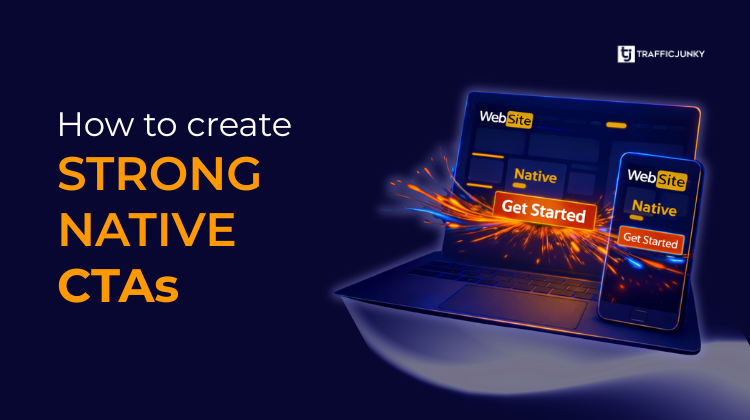
Native ads win or lose on words. Instead of big buttons and animations, your CTA is the combination of headline and brand text that decides whether users scroll past or click on your ad. When you treat every text field as a micro CTA, you turn Native from “cheap traffic” into a predictable performance channel.
Ready to stop paying for clicks that never convert?
The Core Shift: From Brand Labels to Micro CTAs
Most advertisers use Native ad text to label their brand, not to drive action. High-performing Native campaigns treat every text field as a micro CTA that guides the user’s next move.
How to Craft High-Performing Native CTAs
Stop Wasting 60% of Your Native Budget on Useless Clicks
Your header and brand name aren’t just identifiers; they’re your first two conversion tools.
- Header Text = Your Hook
As the primary CTA lever, the header text serves to introduce your offer, trigger curiosity, speak to your audience, and frame the outcome. - Brand Text = Secondary, Supportive CTA
Instead of using the brand text as your passive signature, use it to support your header by reinforcing your offer, clarifying context, and building continuity with your landing page.
When designed to work together, Native ads no longer rely on just enticing creatives or a single line of text. The header attracts and directs, while the brand name strengthens, filters, and motivates.
CTA Functions
When done right, Native ads serve as your pre-click funnels: attracting attention, qualifying traffic, and improving the user experience before they even reach your landing page.
- Curiosity (Earn the click)
Tease outcomes, introduce intrigue, and interrupt scrolling behavior.
- Intent (Pre-qualify the right user)
Call out your target audience, set expectations, and filter out irrelevant traffic.
- Value (motivate the click)
Communicate benefits and outcomes, not brands or features.
- Action (create momentum)
Guide the user to the next step, reduce friction, and make clicking feel natural.
Why Native Ads Underperform (and How to Fix It)
Native ads don’t always fail because of budgeting or incorrect targeting. Usually, they fail because of weak CTAs or mismatched signals.
- Labels instead of CTAs: Brand names and generic headers don’t give users a reason to act. Fix it by replacing “Brand Name – Summer Sale” with a specific outcome: “Cut Your Ad Cost in Half with Smarter CTAs”
- Optimized for clicks, not intent: High CTR with low quality leads to wasted spend and poor conversion rates.
- Lack a clear value signal: Users can’t quickly identify what’s in it for them.
- Misalignment of ad and landing page: The ad promises one experience and the landing page delivers another.
Optimization Loop for TrafficJunky Native Campaigns
Strong Native performance comes from repeated optimization processes, not one-off wins.
- Map CTAs to Funnel Stage
What purpose is the ad serving? Are you trying to draw attention, qualify for intent or drive conversions?
- Separate Roles Across Header and Brand Text Fields
Use the header field to drive clicks and direction, and the brand field to reinforce trust, context, or qualification.
- A/B Test CTA Styles
Test different CTA copies and angles (curiosity, intent, value, action).
- Scale Winning CTA Patterns, not Ads
What angles or propositions does your audience respond best to? Pay attention to what works to efficiently grow your campaigns.
How CTAs Translate into Better Native Campaign Performance
Optimizing Native CTAs improves copy, and more importantly, campaign performance.
- Higher CTR: Curiosity and value-driven CTAs earn more qualified clicks.
- Better Ad Relevance: Clear CTAs align user intent with your landing page and on-site experience.
- More Scalable Native campaigns: Consistent CTA frameworks make it easier to test, refine, and scale winning ads.
Native Ads Outperform Traditional Display Ads
Native advertising is a performance strategy. By matching the look and behavior of the environments they appear in, Native ads bypass banner blindness to reach users when they’re already engaged.
- Stronger purchase intent: Users view Native ads 53% more often than standard display ads.
- Reduced ad fatigue: Native placements drive an 18% higher lift in purchase intent compared to banners.
- Greater visual engagement: Native ads hold attention in the content stream, while traditional display is often ignored.
TrafficJunky Native Ads Outperform Other Ad Networks
TrafficJunky amplifies the advantages of Native ads by placing them in the content streams of the most visited sites globally.
- True Native integration alongside organic content on premium adult publisher sites.
- Massive scale with access to 6.4 billion daily ad impressions.
- Unified campaign control from a dashboard containing analytics and pro-optimization tools like Audience Insights and Vesper.
Upgrade your acquisition funnel with TrafficJunky Native ads